
A “must see” report about the current state of the startup world was just released.
But the report is long and detailed.
So today, I’ll share the one thing I learned from the report that can help you make a lot of money.
This is my #1 Investment Rule for 2026.
Introducing Mike Maples, Jr.
To set the stage here, let me introduce you to Mike Maples, Jr.

Maples is the co-founder of a wildly successful venture-capital firm called Floodgate.
Mike has been on Forbes’ “Midas List” a whopping eight times because of his golden touch with startup investments. His deals include mega-hits like Twitter, Clover Health, Okta, Bazaarvoice, and Demandforce.
Furthermore, before becoming an investor, Mike was founder of two startups that went public: Tivoli Systems (IPO TIVS, acquired by IBM) and Motive (IPO MOTV, acquired by Alcatel-Lucent).
In other words, Maples knows a thing or two about startups and startup investing.
In one of his most important social-media posts, he chimed in about something that’s near and dear to my heart:
Not overpaying for seed-stage startup investments.
As he wrote:
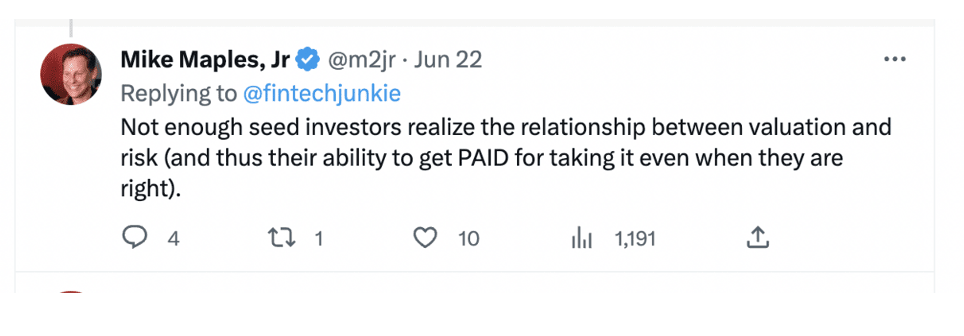
To explain what he means in this post, let me start at the beginning — with the “10x rule.”
The “10x Your Money” Rule
When I first launched Crowdability, I did a deep research project.
My goal was to identify a proven process for picking successful startup investments.
Over the course of a year or so, I sat down with more than three dozen of the most successful startup investors in the country. At the time, these investors had collectively backed more than 1,080 startups, and generated several billion dollars in profits.
Gradually, these professionals revealed dozens of tools and “tricks” to identify winning investments.
But of all their strategies, one has been the most valuable by far:
How to identify the investments that can return 10x your money.
Go with the Odds
In case you didn’t know, startup investors earn their profits in two main ways:
- The startup goes public in an Initial Public Offering (IPO).
- The startup gets acquired.
IPOs can lead to massive profits for startup investors, but they happen infrequently.
The most common way for startup investors to earn their profits is through an acquisition — in other words, when a startup is taken over by another company.
To put the numbers in perspective: in 2025, there were about 200 U.S. IPOs. But during the same time frame, there were about 10,000 significant takeovers.
Given this data, how can we stack the odds in our favor? Let’s take a look.
“Every Battle is Won Before It’s Ever Fought”
To answer this question, let me tell you about one of the investors I met during my startup-research project.
Before this gentleman became a venture capitalist, he was a high-ranking military officer.
As he peppered our conversations with references to “storming the beaches of Normandy” and “the Battle of Little Round Top,” he often mentioned a particular expression:
“Every battle is won before it’s ever fought.”
As these words relate to investing, here’s what he meant:
Certain actions you take before you make an investment can determine your ultimate success. And one of the most important of these actions is this:
Filtering out investments based on their valuation!
The Importance of Valuation
Valuation is another way of saying “market cap.” It’s the total value of a company. For public companies, we say market cap. For startups, we say valuation.
And here’s the thing:
Despite what you read in the press about big-ticket takeovers — like Facebook buying WhatsApp for $19 billion — the sales price for most startups is less than $100 million.
In fact, according to PricewaterhouseCoopers and Thomson Reuters, the majority of acquisitions take place under $50 million.
So, if your goal is to earn 10x your money on a startup that might get acquired for $50 million, how do you “win this battle”?
Simple: invest at valuations of $5 million or less!
If you invest at valuations that are higher than $5 million, you might very well be overpaying for your investment.
Why is this rule so important today?
Well, now we can revisit the “must see” report I mentioned earlier…
New Research Report from Carta
Carta is a tech company that serves startups, investors, and law firms. Essentially, it serves as a “source of truth” for startup ownership, helping startups manage their journey from early-stage startup all the way through a sale or IPO.
As keeper of the “truth,” it has access to a treasure chest of information about what’s happening in the startup world.
And as it just revealed in its “State of Seed 2025” report, the median valuation for a seed round in 2025 was $20 million.

$20 million!
As you just learned, if you invest at valuations higher than $5 million, you might very well be overpaying for your investment.
This $20 million valuation came about partly because of the popularity (and potential profitability) of AI startups. So in some ways, it makes sense. But unless there’s a corresponding increase in “exit” valuations, paying a high price when you make your investment is a losing strategy.
You need to be “picky” about your investments!
Exceptions To Every Rule
Obviously, there are exceptions.
For example, if you have an expert to guide you, you can always consider investing in startups — like SpaceX or Anthropic — that are more highly valued.
After all, many investors considered companies like Facebook or Airbnb “wildly overvalued” when they were worth $10 million, $100 million, even $1 billion. Now they’re worth hundreds of billions, even trillions.
But when you’re just getting started as an early-stage investor — especially if you’re doing so on your own, without guidance — limiting your investments to startups that are valued at $5 million or so is smart. It gives you the greatest chances of potentially earning 10x your money.
That’s what Mike Maples’ tweet is all about:
Don’t overpay for your startup investments!
And now, with valuations rising, that’s my #1 Investment Rule for 2026.
Happy Investing,

